
How to Choose Coat Racks for Offices
A workplace selection guide covering placement, circulation, finish, base, multi-user context and specification questions.
- For
- B2B buyers and project procurement
- Reviewed
- 2026-08-27
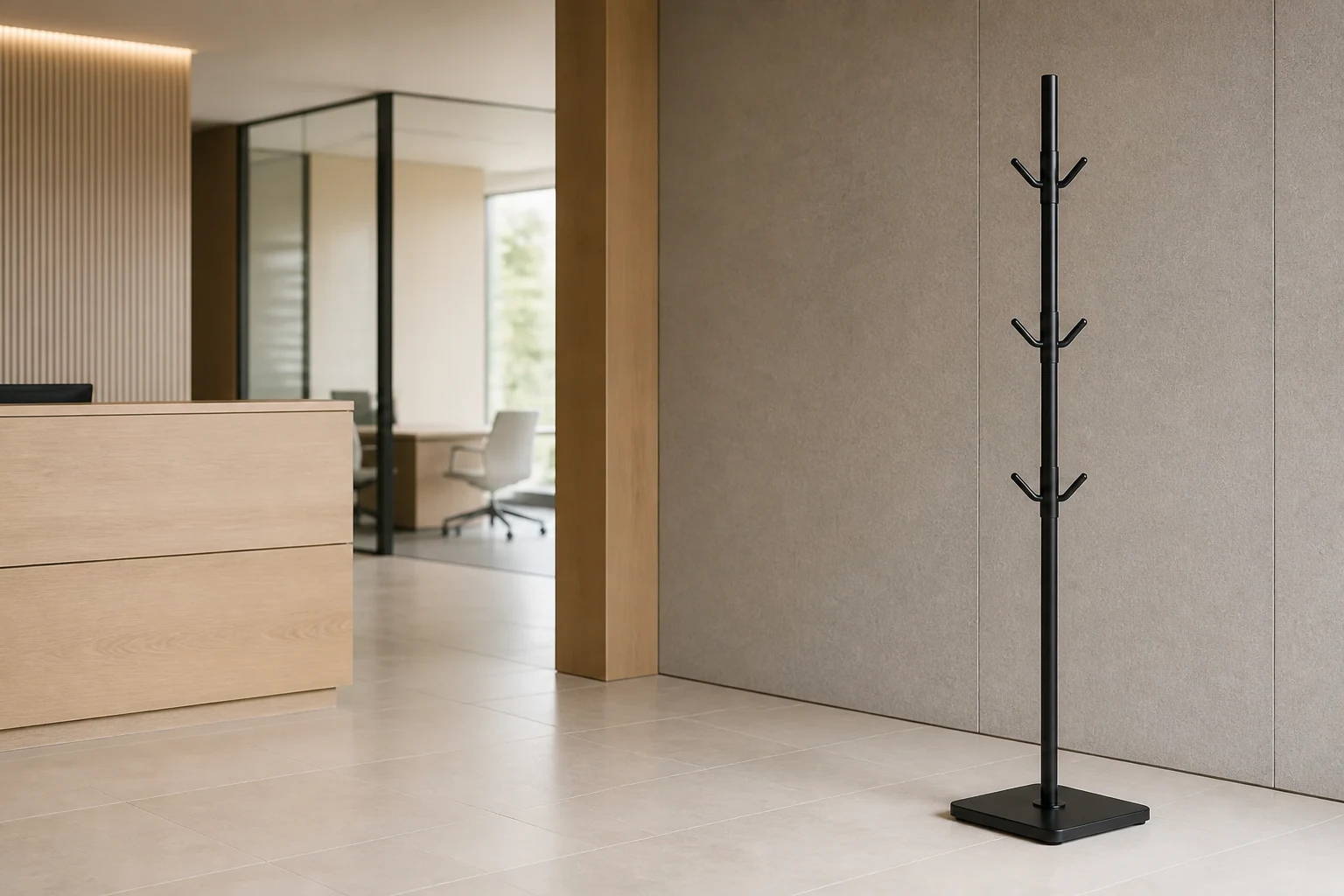
Office coat rack selection should start with the placement zone: reception, executive office, meeting area, shared workspace or staff area. Buyers should then compare footprint, neutral styling, hook access, base geometry and finish before requesting verified dimensions or performance information.
Where will the office coat rack be placed?
Placement determines the first set of constraints, especially circulation, visibility and access.
Reception areas usually need a quiet visual presence outside the main arrival route. Executive offices may prioritize furniture coordination. Shared areas require careful access planning.
Meeting and staff areas should be reviewed against the actual room plan rather than a generic office label.
How should buyers compare floor space and base type?
Measure the usable placement zone, then compare the complete base footprint and orientation.
Tripod or cross bases project feet into the room. Plate and round bases create a low visual anchor but still require confirmed dimensions.
No base type should receive a stability ranking without model-specific evidence.
Which finishes suit commercial interiors?
Neutral black, white and selected wood-grain steel directions are useful starting points, but the workplace palette should decide.
A minimal matte-black form can coordinate with architectural interiors, while wood-grain steel can connect with warmer joinery.
Finish care and sample consistency should be part of the specification discussion.
How should multi-user use be evaluated?
Review hook positions, access and intended garments, then request any required model-specific performance evidence.
The number of visible hooks does not establish load capacity.
If a commercial project has testing or compliance requirements, provide them before product approval rather than assuming certification.
What to confirm before approval
- 01Reception, office, meeting or staff-area placement
- 02Available footprint and circulation
- 03Interior material palette
- 04Base geometry and floor interface
- 05Hook layout and access
- 06Expected garment context
- 07Finish and care requirements
- 08Required testing or documentation
- 09Packing and destination
- 10Shortlisted SKU and quantity
Connect the guide to existing models.
Compare suitable models, then request the current specification and quotation for your order requirements.

Matte Black Tripod Metal Coat Rack
- Material
- Steel tube
- Finish
- Matte black powder-coat direction
A slim matte-black steel coat rack built around a clean silhouette, compact tripod footprint and export-oriented structure.
View Product
White Cross Base Metal Coat Rack
- Material
- Steel tube
- Finish
- White powder coat
A clean white powder-coated steel coat rack with eight hooks and four flat cross feet for residential and office programs.
View Product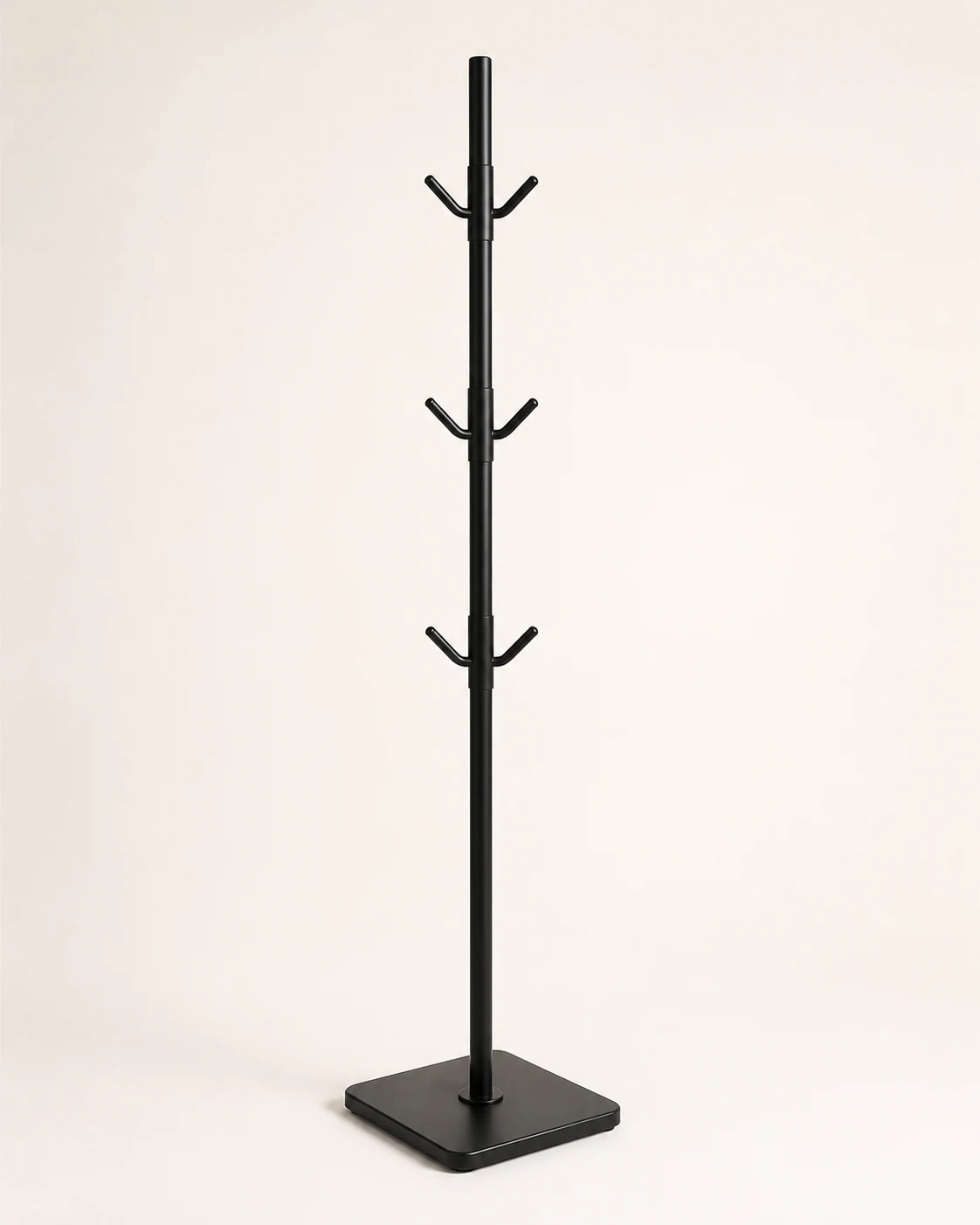
Minimalist Black Square Base Coat Rack
- Material
- Steel tube
- Finish
- Matte black powder coat
A restrained matte-black steel coat rack with six short hooks and a low weighted square plate base.
View Product
Natural Oak Wood Grain Metal Coat Rack
- Material
- Steel tube
- Finish
- Natural oak wood-grain transfer
A steel coat rack with eight hooks and a natural-oak wood-grain transfer finish that keeps the underlying metal construction explicit.
View ProductContinue from education to selection.
Short answers for specification work.
Which coat rack style fits a modern office?
Restrained metal profiles in neutral or wood-grain finishes are useful starting points, subject to the actual interior and placement.
Can hook count be used as a load-capacity figure?
No. Hook count describes layout, not verified load performance.
Should office buyers request commercial certifications?
Buyers should state the standards or documents required by their project or market so applicability can be reviewed.